
The Landscape of talent management in Africa is changing at a remarkable rate, impacted by a unique combination of cultural, economic, and technological variables. As the continent’s economy and population continue to develop, organizations are reconsidering their approaches to human resources. This transformation is not a reaction to external challenges, but rather a purposeful effort to maximize the potential of Africa’s varied workforce.
Organizations around Africa are expanding their investment in training programs to close these disparities. Efforts such as Google’s $1 billion Africa Digitization Initiative and UNESCO’s youth-focused programs have highlighted the significance of upskilling for workforce preparation. Furthermore, countries like Kenya, Nigeria, and Rwanda are establishing standards by linking educational reforms with corporate demands, with a focus on technology and entrepreneurship.
Sub-Saharan Africa saw 10x growth in internet penetration from 2010 to 2024, creating an environment conducive to digital solutions.
To close the talent gap, we must continue to invest in education and workforce development. Governments and the corporate sector must work together to cultivate a dynamic talent pool, using Africa’s unique demographic advantage to support long-term progress. Africa can unveil its workforce potential by focusing digital and soft skills training, which aligns talent capabilities with economic goals.
The Persistent Skills Gap
One of Africa’s most significant barriers to economic prosperity is the persistent skills gap. While the continent boasts the world’s youngest population, many youths remain unemployable due to insufficient skills. Educational systems in many countries still emphasize traditional academic disciplines, leaving technical and vocational training underdeveloped. For instance, UNESCO estimates that only 6% of African students pursue technical and vocational education, compared to the global average of 12%.
The problem extends beyond technical skills. Soft skills — such as communication, teamwork, and problem-solving are equally lacking, yet they are increasingly essential in today’s job market. Employers frequently report that job applicants, though academically qualified, lack practical competencies required to survive in their roles. This mismatch is particularly acute in fast-growing sectors like technology, where roles in software engineering, data analysis, and cybersecurity remain unfilled due to a shortage of trained professionals.
Initiatives to bridge this gap are gaining momentum. For example, Rwanda’s partnership with Carnegie Mellon University to train students in technology fields has been hailed as a model for aligning education with market needs. However, such programs remain the exception rather than the rule across the continent.
Initiatives to close Africa’s talent gap are diverse, reflecting a wide array of efforts across countries. Programs like Nigeria’s 3MTT Program are part of a broader ecosystem of transformative projects aimed at equipping the continent’s workforce with modern skills. Here’s an expanded overview, integrating more initiatives alongside 3MTT:
1. Nigeria’s 3MTT Program
The Three Million Technical Talent (3MTT) initiative focuses on bridging the skills gap by training three million Nigerians in tech and digital skills within five years. It prioritizes key areas like renewable energy, cybersecurity, and software development. Collaboration with tech giants and local institutions ensures the program reaches underserved demographics, with early reports highlighting thousands of beneficiaries in its pilot phase.
2. Nigeria’s Industrial Training Fund (ITF) Programs
The National Industrial Skills Development Programme (NISDP) under the ITF addresses technical skills like welding, plumbing, automotive repair, and tailoring. Over the past five years, this initiative has trained more than 100,000 Nigerians, boosting employability and encouraging entrepreneurship. By working closely with industries and integrating practical training, the ITF plays a significant role in reducing unemployment and supporting small business creation.
3. Kenya’s Ajira Digital Program
Kenya’s Ajira Digital Program equips youth with digital skills to tap into online freelancing opportunities. It has trained over 300,000 individuals, focusing on fields such as transcription, digital marketing, and virtual assistance, effectively connecting participants with the global gig economy.
4. Andela’s Developer Training Program
With its origins in Nigeria, Andela has expanded across the continent, training software engineers and connecting them to global employers. By 2024, Andela had supported over 100,000 young Africans in becoming world-class developers. Its innovative model, which includes paid training and real-world projects, continues to be a game-changer for Africa’s tech industry.
5. Ghana’s Technical and Vocational Education Training (TVET) Reform
Ghana’s Council for Technical and Vocational Education and Training (COTVET) has restructured the vocational training landscape. Through curriculum alignment with industry needs and robust partnerships, the program has made vocational education more attractive and effective. Local apprenticeships and technical hubs have enabled many Ghanaian youth to secure jobs in manufacturing, engineering, and agriculture
6. South Africa’s Harambee Youth Employment Accelerator
South Africa’s Harambee Youth Employment Accelerator connects unemployed youth with opportunities by focusing on job readiness and career guidance. The platform also works closely with employers to match job seekers with roles that fit their skills. By leveraging mobile platforms, Harambee ensures that even rural areas benefit, with over 200,000 youth impacted so far.
7. Rwanda’s Carnegie Mellon Partnership
Rwanda’s collaboration with Carnegie Mellon University provides advanced training in IT and engineering. The program bridges academia and industry, producing graduates who are immediately employable in fields like AI and software development. This partnership serves as a model for integrating world-class education with local market needs.
8. Tunisia’s Start-Up Ecosystem
Programs like Start-Up Tunisia focus on fostering a tech-driven entrepreneurial ecosystem. Offering funding, mentorship, and training, these initiatives provide aspiring entrepreneurs with tools to thrive. Tunisia’s approach emphasizes innovation as a solution to unemployment, encouraging the creation of startups that drive job creation.
9. Microsoft Digital Skills Africa
Microsoft’s Digital Skills Africa initiative provides free training in essential and advanced digital tools, aiming to equip over one million individuals by 2025. The program focuses on reaching marginalized groups, including women and rural populations.
10. Ethiopia’s EdTech Push
Ethiopia has embraced online education to expand access to digital skills training. Collaborations with platforms like Coursera and edX offer free or low-cost courses in programming, data science, and AI. By utilizing online platforms, Ethiopia ensures that even students in remote areas gain access to in-demand skills.
11. YouthConnekt Africa
Headquartered in Rwanda, YouthConnekt provides platforms for entrepreneurship training, job creation, and youth empowerment. Its inclusive approach has supported millions of young Africans through funding and mentorship programs.
Over 600 tech hubs across the continent are nurturing innovation in areas like mobile financial services and e-learning.
The Role of Technology in Talent Management
Digital Recruitment Platforms
Digital platforms are revolutionizing how African companies source, evaluate, and recruit talent. Platforms like Jobberman, Fuzu, and LinkedIn have democratized access to job opportunities by connecting job seekers with employers beyond traditional borders.
- Jobberman, the largest recruitment platform in West Africa, has provided more than 2 million job seekers with opportunities, emphasizing data-driven matching processes to ensure skill alignment with employer needs. In 2023, they launched initiatives targeting youth employment by offering free soft-skills training to bridge the competency gaps among graduates.
- Fuzu, popular in East Africa, combines job postings with career coaching tools, helping users navigate their professional journeys. It integrates AI-driven insights to offer personalized recommendations to job seekers and employers alike.
- LinkedIn enables African professionals to network globally, with over 35 million users on the continent as of 2024. The platform’s talent solutions help employers assess candidates’ competencies through skill endorsements and AI-based profiling.
In addition to Jobberman, Fuzu, and LinkedIn, other platforms like BrighterMonday in East Africa and Careers24 in South Africa have transformed the recruitment landscape. By digitizing the hiring process, these platforms allow companies to access diverse, remote, and skilled talent pools. For instance:
- BrighterMonday has connected over 750,000 job seekers with employers since its launch, offering additional services like CV review and career advice.
- In Nigeria, Jobberman’s Youth Employability Initiative trained over 500,000 youth in soft skills, dramatically increasing their chances of securing employment.
This digital transformation reduces the cost and time of recruitment while increasing access to a diverse talent pool.
AI and Data Analytics
African organizations are increasingly utilizing AI and data analytics to enhance hiring, workforce management, and performance evaluations.
- Predictive Hiring: AI tools analyze patterns in candidate data to predict job performance and retention likelihood. For example, tools like Manatal and Zoho Recruit are now popular in African markets for their ability to filter candidates based on job-specific metrics.
- Workforce Analytics: Tools like SAP SuccessFactors and Oracle HCM Cloud are helping African companies analyze employee productivity and engagement. These insights guide decisions on promotions, team restructuring, and retention strategies. For instance, MTN Group, Africa’s largest telecom provider, uses AI-powered tools to analyze workforce productivity and recommend skill-building programs. Similarly, banks like Standard Bank are adopting AI to streamline internal hiring processes, ensuring the right talent is matched to critical roles.
- Bias Mitigation: AI is also reducing unconscious bias in hiring by using objective data points for decision-making rather than human intuition alone, promoting diversity and inclusion in workplaces.
- As organizations embrace these technologies, they are reshaping talent management into a more data-driven, equitable process.
Virtual Training
E-learning platforms are playing an important role in bridging Africa’s skills gap, offering accessible and affordable opportunities for workforce reskilling and upskilling.
- Global Platforms: Platforms like Coursera and Udemy are providing African professionals with courses in areas like data science, project management, and digital marketing. Coursera reports a significant increase in African enrollments, with over 5 million users from the region in 2023.
- Localized Solutions: African startups like uLesson and Moringa School focus on tailoring content to regional needs. uLesson, for instance, incorporates local curricula in its training, targeting secondary and post-secondary learners with digital tools.
- Corporate Training Initiatives: Companies like Microsoft and Google have partnered with governments to deliver digital skills training to millions of young Africans. Microsoft’s Global Skills Initiative has trained over 3 million individuals in Africa, equipping them with in-demand tech skills like cloud computing and AI. Google Africa’s Digital Skills for Africa Program aims to train 10 million Africans in digital skills, with over 5 million trained as of 2023, focusing on areas like SEO, analytics, and e-commerce; Mastercard Foundation’s Young Africa Works Initiative collaborates with institutions like uLesson to provide affordable, region-specific e-learning solutions.
These platforms are bridging educational and technological gaps, empowering the workforce to meet the demands of a rapidly digitizing economy.
Africa’s digital economy is projected to reach $180 billion by 2025 and $712 billion by 2050, driven largely by advancements in digital recruitment and training.
Diversity and Inclusion in Talent Management
Diversity and inclusion have become vital to shaping talent management strategies in Africa. As the continent continues to grow economically and socially, addressing disparities in education, employment, and workforce representation is not just a moral imperative but an economic necessity.
Women are key drivers of Africa’s development, yet they remain underrepresented in education and formal employment. The challenges are rooted in systemic barriers such as limited access to education, societal norms, and discrimination in hiring practices. However, targeted efforts are beginning to yield results.
- Affirmative Finance Action for Women in Africa (AFAWA):
AFAWA, led by the African Development Bank, is a game-changer for women entrepreneurs. It aims to close the $42 billion financing gap faced by African women-led businesses. By 2023, the initiative mobilized over $450 million, helping women access loans, build business capacity, and connect with markets. - SheTrades Initiative:
This International Trade Centre program has empowered thousands of women entrepreneurs by equipping them with the skills and resources to access global markets. By providing training on export strategies and linking them with buyers, SheTrades targets enabling 3 million women entrepreneurs by 2030. - Educational Initiatives for Girls:
Programs like Girls in ICT, supported by the International Telecommunication Union (ITU), resolve the gender imbalance in technology fields. These efforts inspire and train girls, preparing them to excel in STEM careers, a sector critical to Africa’s future.
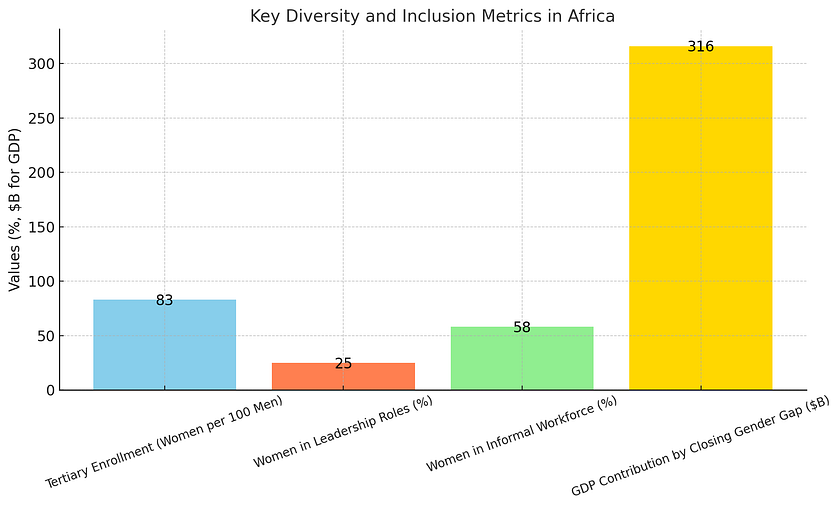
Tertiary Education: For every 100 men enrolled in tertiary education, only 83 women are enrolled, indicating a persistent gap.
Workforce Participation: Women dominate the informal workforce, making up 58%, yet hold only 25% of leadership roles.
Economic Contribution: McKinsey estimates that closing gender gaps in the workforce could add $316 billion to Africa’s GDP by 2025.
Inclusion of Persons with Disabilities and Underserved Communities
The inclusion of persons with disabilities (PwDs) and underserved communities in the workforce remains a pressing issue. Despite legal frameworks and growing awareness, these groups face disproportionate barriers to employment.
- Disability Inclusion Policies:
Countries like Kenya and South Africa have enacted laws mandating inclusive hiring practices. For example, South Africa’s Employment Equity Act requires employers to achieve equitable representation of PwDs in the workplace. - Training Programs for PwDs:
Organizations like Action on Disability and Development (ADD) have launched skill-building initiatives across Africa. In Uganda, ADD has trained over 3,000 individuals in trades like carpentry and ICT, significantly boosting employability. - Corporate Inclusion Efforts:
Companies like Safaricom are setting examples by adopting inclusive hiring practices. Safaricom reports that 2% of its workforce comprises PwDs, a step towards meeting Kenya’s legal mandate.
Efforts to include rural populations and ethnic minorities are also on the rise.
Benefits of Embracing Diversity and Inclusion
- Economic Growth:
Beyond the GDP boost from gender equality, PwD inclusion and workforce diversity drive productivity. Studies show that diverse teams are 35% more likely to outperform less inclusive counterparts. - Innovation and Creativity:
A diverse workforce fosters varied perspectives, which are crucial for innovation in sectors like tech, manufacturing, and services. - Social Impact:
Tackling diversity strengthens communities by reducing poverty and creating opportunities for marginalized groups.Organizations - Organizational Impact:
When people feel valued and included, they become more motivated and loyal. This improves retention rates and saves companies from the constant cycle of hiring and training new staff. Diverse teams bring different viewpoints to the table, helping to avoid groupthink and leading to smarter, well-rounded decisions. These insights enable businesses to expand their reach and create better products or services. - Cultural Impact: When people from different backgrounds work together, they learn to understand and respect each other’s perspectives. This promotes empathy and teamwork.
Challenges and Opportunities
Despite progress, challenges remain:
- Cultural Norms: Deep-seated stereotypes about gender and disability hinder progress.
- Policy Gaps: While policies exist, implementation often falls short due to weak enforcement.
- Access to Education and Skills Training: Rural areas and marginalized communities still lack access to quality education and training programs.
The opportunities, however, are immense. By investing in inclusive policies and programs, Africa can not only boost its economic output but also build a fairer, more equitable society.
Visual Representation
To understand the state of diversity and inclusion in Africa, here is a visual breakdown:
- Tertiary Enrollment Gender Parity: Women account for 83% of male enrollment levels.
- Informal Workforce Participation: Women make up 58% of the informal workforce, showcasing their economic role despite structural barriers.
- GDP Impact: Closing the gender gap could add $316 billion to Africa’s GDP by 2025.
- PwD Representation in Workplaces: Corporate efforts like Safaricom’s inclusion programs show progress but remain limited to a few organizations.
Industry-Specific Talent Needs
Tech
The rapid evolution of the tech sector is driving up demand for skilled personnel. Software developers are essential for building innovative platforms and applications that power everything from social media to financial systems. Cybersecurity experts are increasingly sought after as businesses grapple with protecting sensitive data in a world of escalating cyber threats. Meanwhile, the rise of artificial intelligence (AI) has spurred a surge in the need for AI specialists who can develop and manage intelligent systems, from machine learning algorithms to robotics. These roles are not just vital for tech companies but for nearly every industry, as businesses digitize their operations and rely more heavily on technology to stay competitive.
Healthcare
The healthcare sector is facing a talent crunch, with many countries struggling to recruit and retain qualified professionals. This shortage is particularly pronounced in areas like nursing, where demand consistently outpaces supply. Additionally, the need for specialized roles such as mental health practitioners, geriatric care specialists, and telemedicine providers has grown significantly in recent years. The challenge isn’t just finding skilled individuals but also creating work environments that promote long-term retention by addressing issues like burnout, inadequate resources, and competitive salaries. As healthcare systems become more reliant on technology, there’s also a growing need for professionals who can seamlessly integrate digital health solutions like electronic medical records and wearable health devices into patient care.
Agriculture
Modernizing agriculture is essential for feeding a growing global population and addressing climate challenges, yet the industry faces a talent gap. Agritech skills are becoming indispensable as farmers and agricultural businesses adopt advanced technologies like drones for crop monitoring, precision farming tools, and AI-driven supply chain management. Expertise in data analysis is also crucial for optimizing yield and minimizing waste. Beyond technical skills, there’s a rising demand for individuals who can navigate the intersection of sustainability and agribusiness, balancing productivity with environmental stewardship. Governments and private sector players alike are pushing for upskilling initiatives to equip the workforce with the tools needed to drive agricultural innovation.
Each industry faces unique challenges, but a common thread is the need for continuous learning and adaptation. Bridging these talent gaps requires collaboration between governments, educational institutions, and industries to create targeted training programs, encourage innovation, and provide clear career pathways. Addressing these needs isn’t just about filling jobs, it’s about ensuring industries have the skilled workforce they need to thrive in the future.
Are you ready to tackle the talent challenges in your industry and stay ahead in today’s fast-changing world? Whether you’re a business leader, an educator, or someone passionate about making a difference, the time to act is now.
Let’s work together to build a skilled, innovative, and resilient workforce. Share your thoughts, connect with others, and take the first step toward shaping a stronger future!
Stay connected with us for more updates:
Website || Email || IG ||Linkedln || Twitter || Whatsapp Us