

What does progress look like when it speaks Arabic in Doha and Yoruba in Lagos?
How do women rise when their platforms are policy reforms in Qatar or pop-up markets in Nigeria.
Across Africa and the Middle East, the conversation around women’s leadership has shifted. No longer is the question if inclusion matters — it’s how to embed it into the very structure of economies, institutions, and public systems.
At BGR, we don’t chase inspiration. We design ecosystems — practical, people-centered, and policy-aligned solutions that enable inclusive leadership to take root and thrive.
This year at the Qatar Economic Forum, we spotlight the multiplying power of collaboration:
- Between continents
- Across public and private sectors
- And most importantly between women leaders rewriting the rules from the ground up
Across the GCC, reforms are moving fast. Saudi Arabia’s female labor participation has more than doubled since 2017, now exceeding 37%. In Qatar, women represent 51% of the labor force — but only ~12% of startups are female-led. The number is rising, but systemic funding and mentorship gaps persist.
Meanwhile, Africa tells a different story.
- Nigeria: Women own 41% of businesses, the highest in Africa (GEM 2023)
- Rwanda: 61% of parliamentarians are women — the world’s highest
- Ethiopia & South Africa: Gender parity in cabinets, pushing inclusive governance
But challenges remain: just 15% of women-led businesses in Nigeria have access to formal capital. Legal and infrastructure barriers keep many stuck at subsistence levels.
The Middle East is building top-down reform engines, while Africa excels in bottom-up resilience and innovation. But without better integration, both risk leaving potential on the table.
What’s Missing? Ecosystem Thinking
Leadership cannot be scaled through isolated programs or symbolic initiatives. It requires an ecosystem approach, built around three pillars:
1. Skills to Lead
Women need more than inspiration — they need the technical, political, and digital fluency to lead across sectors.
At BGR, our programs go beyond capacity-building. We engineer learning experiences that connect skills with influence — across public service, business, and innovation.
2. Structures to Sustain Growth
From venture capital to government policy, women’s success is often stunted by missing middle infrastructure.
In MENA, only 2% of venture capital reaches female founders (WEF 2023).
In Sub-Saharan Africa, 70% of women entrepreneurs lack access to formal financial services.
At BGR, we help align institutions to policy, ensuring that governments, donors, and banks move from intent to investment.
3. Networks to Multiply Impact
No leader thrives in isolation.
That’s why BGR partners with platforms like WIMBIZ, Regalia, and African Women on Board, creating cross-continental pipelines for:
- Women-led startups
- Civil servants and technocrats
- Community-level change agents
These partnerships don’t just exchange knowledge, they build a shared power base.
The Qatar–Nigeria Parallel
Let’s break it down.
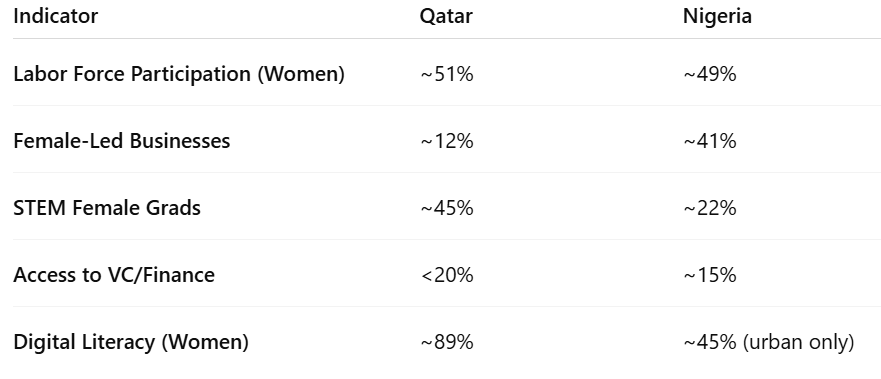
Qatar & Nigeria: A Comparative Snapshot

Qatar has the policy and digital infrastructure, but needs stronger grassroots momentum. Nigeria has the entrepreneurial muscle, but lacks enabling policies and systems.
Qatar’s institutional strength and digital focus could supercharge Nigeria’s grassroots entrepreneurship. Nigeria’s entrepreneurial scale and bottom-up innovation could reshape how the GCC thinks about impact at scale.

What BGR Does Differently
BGR’s model goes beyond “support.” We engineer success systems for women in leadership by:
- Designing public sector learning labs for female civil servants
- Embedding leadership training into youth and STEM ecosystems
- Connecting African and Gulf institutions to co-develop gender equity policies
- Facilitating capital matchmaking between funders and underrepresented founders
- Launching joint policy-entrepreneur pipelines that create measurable outcomes.
For example: At our recent Regalia Pop-Up in Lagos, over 70 women entrepreneurs received brand-building, pitch training, and access to capital conversations. That model is now being explored for GCC adaptation.
Collaboration is now essential; it is no longer an afterthought.
Without structural design, even the most talented leaders will hit ceilings.
Without cross-border collaboration, even the best policies will underdeliver.
At #QEF2025, BGR brings a bold proposition:
Let’s stop fixing women and start fixing systems.Let’s go beyond panels and pledges.
Let’s co-build leadership that lasts.
Leadership is not inherited. It’s engineered.
And the future? It’s already being built by women, who are ready to lead, and institutions brave enough to back them.
What would happen if Africa’s entrepreneurial spirit and the Middle East’s policy innovation finally aligned — not in theory, but in infrastructure?
That’s the question we’re answering at #QEF2025.
Let’s co-design what inclusive leadership looks like — not just for women, but with them.
Let’s move from conversations to coalitions.
Let’s stop fixing women and start fixing the systems around them.
If you’re ready to co-create bold, equitable ecosystems — BGR is ready to build with you.
Visit the website for more info :