
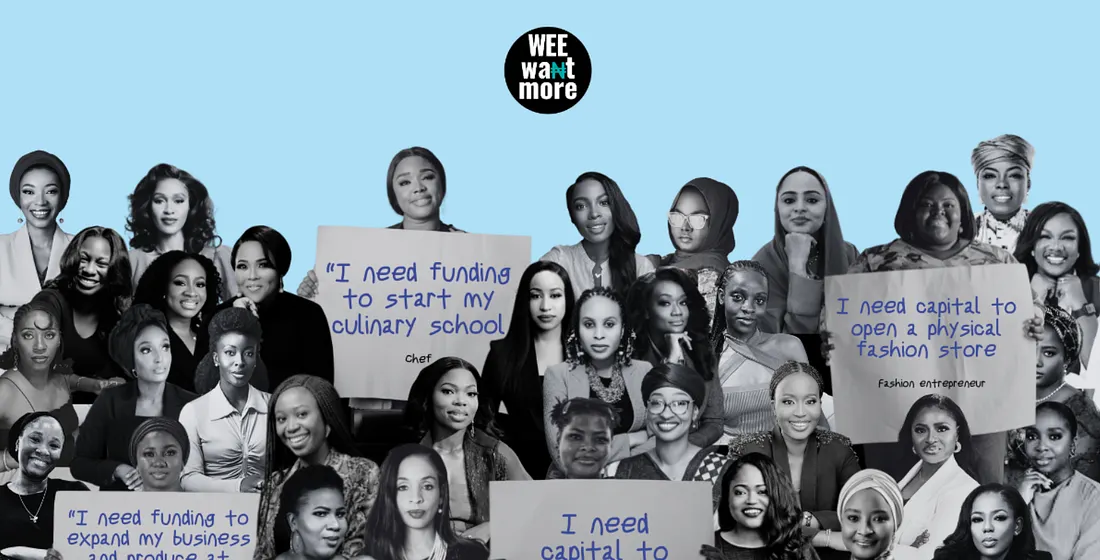

In the heart of Africa’s economic potential lies an untapped powerhouse: women entrepreneurs. Despite contributing significantly to national GDPs and sustaining livelihoods, women continue to face a systemic funding drought. While institutions and governments tout gender equality, the numbers reveal a story of exclusion, underestimation, and systemic neglect
t BGR, our 2025 strategy centers on equity, leadership, youth development, and systemic impact and today, we raise our voice on one of the continent’s most urgent challenges: financing African women in business.
In an effort to change this, a group of Nigerian women, including Folu Storms, Jemima Osunde, Abosede George-Ogan, Omowunmi Akingbohungbe, Tosin Olaseinde, Lehle Balde, Habibah Waziri, Sa’adatu Hamu-Aliyu, Ekemini Akpakan, Fola Ibowu, Mojisola Humponu-Wosu, and Chioma “Chigurl” Omeruah, have launched a new campaign called WEEwa₦tMore, calling on the nation’s top financial decision-makers to remove structural obstacles to financing women-owned enterprises.

In order to provide funding for female entrepreneurs, they urged Nigeria’s most influential financial institutions to act immediately and permanently. Policymakers like Central Bank Governor Olayemi Cardoso, Finance Minister Wale Edun, Industry, Trade, and Investment Minister Dr. Jumoke Oduwole, Minister of State John Owan Enoh, and the CEOs of the Bank of Industry (BOI) and Small and Medium Enterprises Development Agency of Nigeria (SMEDAN), as well as CEOs of significant Nigerian banks, are directly challenged by the campaign.
Only 7% of Africa’s startup funding goes to women-led businesses.
95% of loans taken by women are repaid, yet banks label them “high risk”.
This isn’t about potential , it’s about access. The barriers are deeply entrenched:
- Collateral requirements that exclude women, many of whom lack formal asset ownership.
- Gender bias in investor networks dominated by men.
- Limited access to financial literacy programs, especially in rural areas.
- Cultural norms that still discourage female entrepreneurship in many regions.
When women rise, so do communities. A 2023 meta-study from the Journal of Business Research emphasized that women entrepreneurs reinvest up to 90% of their income into their families, significantly improving education, health, and economic resilience.

“When women win, everyone wins. So why are the doors still locked?” — Habibah Waziri, MD BGR
Banking on Bias
Banks, despite the availability of creditworthiness data, often deny women entrepreneurs fair financial access. The barriers include:
- Collateral Requirements: Women often lack land or property ownership, which banks demand.
- Gender Stereotypes: Risk perception is deeply gendered; women are viewed as “less capable” despite stronger loan repayment records.
- Informal Sector Challenges: Many women operate in informal markets, sidelining them from formal finance systems.
- Low Digital Literacy: Digital tools, which now play a key role in fintech-based funding, often exclude rural women.
When women rise, so do communities. A 2023 meta-study from the Journal of Business Research emphasized that women entrepreneurs reinvest up to 90% of their income into their families, significantly improving education, health, and economic resilience.

Moreover, Africa’s youth bulge with more than 60% under 25 demands scalable, inclusive economies. Empowering women-led businesses is critical to unlocking jobs, innovation, and stability.
“You lock us out, then say we didn’t show up. That’s not equity — that’s sabotage.”
— Aisha Yesufu, activist“You can’t claim to support women if you don’t fund them. Capital is oxygen.”
— Arese Ugwu, author of The Smart Money Woman
“Women-led businesses are profitable, scalable, and sustainable. Why are we not funding them?”
— Oluwatosin Olaseinde, founder of Money Africa
Glimmers of Progress — But Not Enough
Programs like Sterling Bank’s SWAY and AgFin have begun shifting tides, committing over $33 million to women in agri-business. But $33 million across an entire sector and gender is a fraction of what’s needed.
As Habibah Waziri rightly asks:
“We see the programs — but where are the results? Show us the numbers.”
“Financial equity cannot be a one-time campaign…it must be a sustained commitment to empower women in business.
The Women Behind the Movement — Voices That Demand Equity
This movement is fueled by some of Nigeria’s most visionary women leaders. Here’s what they had to say:

We believe in action not applause. Women don’t need charity. They need capital, confidence, and commitment from those in power.
At BGR, we propose a shift from tokenism to transformative action.
We are not just echoing this call…We’re embedding it.
- We deliver training and capacity-building for women entrepreneurs.
- We co-design inclusive financial tools with private sector partners.
- We advocate policy shifts that favor inclusion and innovation.
“If inclusion is real, let’s see the metrics. Talking is easy. Action is accountability.”
— Eniola Edun
✅ Here’s our call to financial institutions:

- Reserve 40% of MSME loan portfolios for women.
- Simplify collateral requirements — consider group lending, guarantees, and asset-free alternatives.
- Disclose funding statistics by gender — transparency drives accountability.
- Develop financial products tailored for women in agriculture, trade, tech, and services.
- Embed women-focused funds into ESG (Environmental, Social, Governance) and impact investing frameworks.
Financial equity is not charity, it’s an investment in Africa’s most consistent changemakers.
Women are not a niche market. They are half the population, half the economy, and often the most effective return on investment. Investing in women entrepreneurs is not just the right thing to do, it’s the smartest economic decision Africa can make.
The future is female-funded or it’s underfunded. Which side will you be on?
✊🏽 Join the Movement
Fund Women. Fund Nigeria’s Growth.
It’s time to move past token initiatives and invest in women as infrastructure.
Because when women earn, Nigeria grows.
Sign the petition now. Join the WEEwa₦tMore campaign.
Call on banks to disclose, simplify, and commit. Share this blog.
#WEEwa₦tMore #InvestInWomen #BGRForEquity
Website || Email// IG || Linkedln || Twitter Whatsapp Contact : [+234–814–312–1400]